Showing posts with label Anatomy. Show all posts

Friday, 9 December 2016

New Anatomy / Physiology, App

An Irish developed app has been listed by Apple as one of the 16 most innovative apps and games for 2016

Complete Anatomy, designed by Dublin-based 3D4Medical, beat competition from two million other apps that were published in Apple's App Store this year.
The app gives people learning anatomy or physiology a 3D view of the body, layer by layer, and allows the user to zoom, rotate, cut through structures and see behind layers.
Recordings can also be made for educational purposes, and content can be shared via the cloud.
The App Store Best of 2016 shortlist was picked by Apple's Editorial Team.
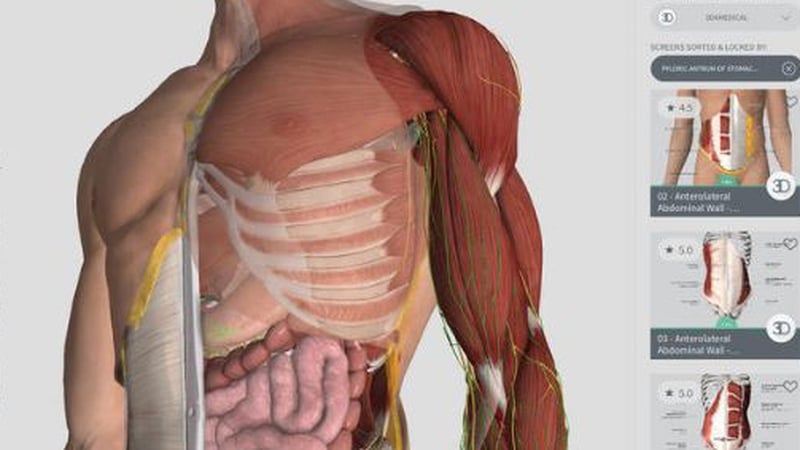
A screenshot of the 3D4Medical app from Apple iTunes Store
A screenshot of the 3D4Medical app from Apple

Last year Complete Anatomy received the Apple Design Award for its technical excellence and outstanding design and innovation, and was also featured on stage by Apple during a high-profile iPad product launch.
The app has reached the top of the app store medical charts in 148 countries, and the overall charts in the online shop in 52 states.
At the start of this year, 3D4Medical announced it was taking on 70 new staff as it bolstered its product development line and grew sales overseas.

Thursday, 28 April 2016

Tuesday, 31 March 2015

Tuesday, 3 February 2015

Lunchtime Lecture: 'Bodies of Knowledge', Wednesday 4th February, Hardiman Building


The Special Collections Lunchtime Lectures Series 2014-2015 will continue on Wednesday Feb. 4th, in Room G011 Seminar Room in the Hardiman Building at 1pm, with "Bodies of knowledge : the early days of anatomy in Galway" by Alexander Black, Anatomy, School of Medicine.

Anatomy was one of the founding departments of Queen's College Galway and was viewed at the time as a rather distasteful, if necessary, field of study, yet to be completely separated from its sibling discipline physiology. Anatomy is a visual and tactile subject, and perhaps relies on images and illustrations more than any other academic discipline.  This talk will cover the early days of anatomy in Galway, and will illustrate the importance of anatomy to society, society to anatomy, and medical imaging to medicine.

A selection of anatomy material from the Old Library Collection will be on display during the talk, and all are welcome to the G011 Seminar Room in the Hardiman Building at 1pm.

The accompanying "Art of the Unseen" exhibition of anatomical illustration will run in the Special Collections Reading Room during the month of February.

Thursday, 16 October 2014

Principles of Human Anatomy 13th Edition

The 13th edition of the popular Anatomy book Principles of Human Anatomy by Gerard Tortora has now arrived in the Nursing & Midwifery Library Located at 611 TOR


Tuesday, 7 October 2014

UCC researchers investigate why some can resist stress

From left: Dr. Olivia O'Leary, Dr. Daniela Felice & Prof. John F. Cryan

Why on the rollercoaster of life are some people more resilient to the negative effects of stress than others?
Now University College Cork neuroscientists show that certain receptors in the brain play an important role in determining how we respond to different types of stress.  Their research is being published today in the prestigious international journal Proceedings of the National Academy of Sciences USA. 
Scientists based at the Dept of Anatomy & Neuroscience and the Alimentary Pharmabiotic Centre in University College Cork, Cork, Ireland have identified a novel molecular mechanism that determines how the brain responds to chronic stress.  Prof John Cryan and Dr Olivia O’Leary, together with their PhD student Daniela Felice and their colleagues have shown that different subtypes of a given receptor (the GABAB receptor) can confer vulnerability to stress (both in early-life and in adulthood).  
Dr O’Leary says “although it is early days, these data show that these receptors could be important targets for the development of new drugs in the treatment of depression, where there is still such an unmet medical need”.  Indeed, Prof Cryan says that “understanding the molecular factors that enable the brain to be stress resilient is one of the most exciting areas in neuroscience research currently and these data position the GABAB receptor at the heart of such efforts”, “we still have some way to go to translate these findings into humans but we are very excited by these data“ Cryan continued.  

Friday, 2 May 2014

NUI Galway Start-Up Pocket Anatomy Picked From 100 European Start-Ups To Win Next Web Start-Up Prize


Pocket Anatomy, a start-up based in NUI Galway’s incubation centre has won the ‘Boost’ startup competition at The Next Web Conference in Amsterdam. Pocket Anatomy, from nearly one hundred entrants, was one of ten selected to attend the conference in Amsterdam by popular vote.

Pocket Anatomy CEO Mark Campbell said this was a big win for the company .  Pocket Anatomy's award-winning 3D visual software solution is the Google Earth for healthcare, facilitating doctor-patient diagnoses communication and promoting patient well-being and personal healthcare understanding.

The target markets are:


  • Healthcare Professionals who need to communicate and explain anatomical abnormalities and health conditions with patients.
  • Healthcare Consumers (healthy and unhealthy) who need to understand prevention and well-being. 
“It’s fantastic that Ireland is punching above its weight in the healthcare and medical innovation space, with Pocket Anatomy receiving the top startup award at The Next Web Conference, and also recently joining the StartUp Health Academy,” said Dr John Breslin from NUI Galway, an advisor to Pocket Anatomy. 

Pocket Anatomy is based in NUI Galway’s Business Innovation Centre which provides an entrepreneurial working environment, general business advice and advice on access to finance, serviced office space and meeting facilities for start-ups and NUI Galway spin out companies.


View more information here